Ops leaders struggle to assess customer demand related risks in real time. This increases revenue risk. This is a bigger issue amid rising uncertainties like tariffs and inflation (circa 2025). Learn one of the many ways how Zyom helps customers such as Cambium Networks tackle Revenue risks.
Most Operations leaders can’t answer in real time, or even near real time:
Which portion of my planned customer demand is at risk this quarter?
Which orders are at risk?
“At risk” here implies a significant likelihood that customer orders would not materialize, or even if it does, cannot be shipped on time.
Changing signals make it impossible to get demand and supply plans aligned, even using well-crafted spreadsheets and sophisticated, but siloed systems — planning cycles drag, errors creep in, critical Revenue and cross-functional meetings and forums (such as Sales & Ops Planning or S&OP) result in more unanswered questions, and by the time the risks are visible, revenue is already slipping away, or worse (orders lost to competitors).
In times of “garden variety” uncertainty these questions to uncover risk are hard to answer. In an environment of high uncertainty such as now (starting circa Q4 , 2024, to late Q3, 2025 in the US), identifying demand risk has become increasingly frustrating. Largely due to tariffs and pressured trade relations which directly impacts significant trade volumes from partners across the board (larger partners such as the EU, Japan, South Korea, and relatively smaller ones like Vietnam), these risks have increasingly grown for US based product companies. And this without taking into account the slowing employment picture and persistent inflationary trends which, in many industries, is already dampening if not damaging demand.
Branded product manufacturers like Cambium Networks cut planning cycles by 60%-80% and gave key executives and operating team members direct line-of-sight into supply risk with Zyom, starting in 2017. Their SVP of Ops called it “a system that brought our vision to fruition.” Cambium continues to partner with Zyom as it navigates demand corrosive uncertainties.
If you can’t see revenue at risk until the quarter’s target is already slipping, and key operating team members are scrambling to get supply inbound, you’re too late.
Key Questions for COO and Operations team
What is one key system capability from a supply Operations standpoint that companies such as Cambium need to ensure they spot revenue risk as early as possible? How should this capability evolve?
What is one valuable decision prompt that the system can automatically provide to speed up decisions and actions from Supply Operations? This was not technically feasible prior to the advent of the newer generative AI technologies (late 2022 ChatGPT launch). i.e., traditional Machine Learning approaches till the public advent of GenAI (LLM) technologies.
To find out more, drop a comment here, or email us at: products@zyom.com
Sources & Acknowledgement: Zyom’s Cambium Networks Case Study.
John Duvenage provided key inputs to structure and composition.
Disclaimer: Generative AI was not used for composing any of the writeups on this site (including this one). GenAI was used to generate the pictures in this article and for content summarization. At this point of time, there is no plan to use GenAI to generate new content on this site. Readers will be informed in advance if this changes.
Effective inventory management is vital for companies operating across regions, especially during demand uncertainty. While healthy inventory levels provide an advantage, rising inventory levels can become a financial burden quickly. Channel inventory, in particular, can be misleading, masking underlying inefficiencies and costs. This article explores how COOs can increase a company’s focus and optimize inventory across the value network, enhancing efficiency and reducing risks that could undermine even well-run companies. UPDATE – don’t forget the Action section at the end.
In the Finance function “inventory,” as a default, is reported as a “Current Asset.” Ask those in Supply Operations. They’ll tell you that nothing could be farther from the truth. This is especially true in times when demand uncertainty[1] grows.
Managing inventory in companies that manufacture and ship products is a demanding exercise. It requires careful consideration of all the variables that impact demand and supply at various nodes of the value network (not just the supply network). Decisions have to be calibrated using data and inputs across functions – decisions, often based on approximations and imperfect information. And it must be done on an ongoing basis, otherwise important data or signals can slip through the cracks.
It becomes even more complex in cases where companies sell through channel partners (distributors, VARs[2], etc.).
Channel inventory, specifically Distributor inventory, is deceptive. Although, it is no longer on your company’s books, you are not off the hook for it either. Among many things, it depends on the skills of the channel partner in managing inventory and reordering, your contractual relationships, and other factors – such as inventory and ordering patterns across your value network.
If demand changes significantly, then orders for your products can swing up or down. Inventory sitting at your channel partners can also be returned in some cases (“stock rotation” for instance). This can lead to unforeseen reduction in your Revenue. Costs will also increase as you restock your channels with newer products and take receipt of older stock. In times of heightened and persistent demand uncertainty, it does not take too long before inventory is no longer an asset, but more a noose around a company’s neck.
In times of heightened and persistent demand uncertainty, it does not take too long before inventory is no longer an asset, but more a noose around a company’s neck
[1] measured by the rate of change of demand variability and demand volatility; *H1, 2025 has been a period of heightened uncertainty driven by the many sizeable tariffs directed by the US against global trading partners, “reciprocal tariffs” being the latest shell to drop in a scarred global trade-war landscape ; the impact of this on demand uncertainty (variability), already evident in many industry segments (based on direct and secondary data) is yet unfolding.
The dual-mandate of inventory, structural implications
This results in the “dual mandate” faced by the COO and team, balancing two important but opposing needs –
– Carry enough inventory, including buffers, so you fulfill customer orders as needed, as they arrive
And
– Keep Inventory levels low so you do not have too much capital (money) tied up in stock, to run your operations
Compare two companies (illustrative example) –
For example, Company “A” that is carrying $500 Million in average inventory to fulfill $1 Billion of Revenue in a quarter,
versus
Company “B” that’s carrying $300 Million in inventory to fulfill the same level of Revenue – i.e., $1 Billion in a quarter
Company B has a significant structural advantage over company A.
So, inventory reduction is not an arcane, tactical task only to be initiated due to a near-term blip. Go ask your Supply Operations leader[1] to drive down inventory by x% (40%, as in the example above). And everything will be fine.
It is a critical initiative to drive down the capital requirements that gives your company a structural capital advantage. This requires careful attention to details while keeping an eagle-eye on the goal.
If you get this right, you can go much faster up the revenue and growth curve, having more freed up capital via healthy margins to allocate to smart growth (Revenue generating) initiatives.
Get it wrong, and you will not even know something is amiss for a long time. Then things can turn ugly quickly.
Get it (Inventory initiative) wrong, and you will not even know something is amiss for a long time, and then things can turn ugly quickly.
But inventory reduction, especially in channel centered selling models, is even more complex and difficult, as our experience and research shows. This is true whether you manufacture in-house or utilize outsourced manufacturing.
Status quo is often the biggest enemy.
David Cote (ex- CEO of Honeywell) articulates this well with a short story of his experiences as CFO at GE’s major appliance business, in his book – Winning Now, Winning Later (see “References” section at the end).
David’s story provides broad brush strokes on the key leadership mandate and insights gained. As a part of Zyom, we have worked closely with our customers’ cross-functional Operations team and their leadership in the trenches. We have been focused on achieving similar results in operations process optimization for our customers’ operations at physical product companies.
A key part of our customers’ successes has been our ability to collectively dive into the demanding details.
And, in almost all cases, we have come away with surprising findings as we have rolled out our end-to-end planning and execution framework and Operations Management Support (OMS) software system across product companies. Companies that were at different phases of their growth and development cycle.
We do not have inventory reduction numbers that we can share here. What is clear is that by slashing the end-to-end planning cycles by over 80%[2], we helped them achieve significant capital efficiencies – something they had not experienced before. How?
Very briefly – by achieving increased process velocity, across a focused set of end-to-end processes.
by slashing the end-to-end planning cycles by over 80%, we helped our customers achieve significant capital efficiencies – something … not experienced before. How? .. by achieving increased process velocity, across a focused set of end-to-end processes
The sustained[3]structural cost advantages that customers gained has freed up scarce capital which can now be allocated to other critical initiatives. This gives them an unprecedented operating advantage.
[1] working with Channel Sales depending on where inventory is high
[2] Based on analysis conducted and vetted by our customers
[3] Cost advantages achieved are structural (lower inventory levels to ship out the same revenue), hence recurring
Inventory levels rising ? Watch out!
Inventory (specifically, Channel inventory) is a double-edged sword. On the one hand, maintaining near-optimal channel inventory levels provides a competitive edge by ensuring fast and cost-effective order fulfillment. On the other hand, if inventory levels creep up too high, it can quickly become a noose around your neck – a heavy financial burden.
Left unchecked, rising inventory can impair your company’s financial performance in the near to middle term. This due to carrying much higher inventory levels for the amount of revenue shipped.
In case revenue growth shifts or slows down, you will be left holding the bag on ship-loads of inventory (much of which must be written down or written off).
Longer term, this will push your company into a corner, impairing your competitive standing.
As a Chief Operations Officer, you must ensure your inventory optimization initiative always bubble up to the very top. Make this a strategic initiative. Ensure ongoing support from the senior leadership. Mobilize all team members. Ensure it’s not just a tactical one-off.
See the ‘Actions’ block below. Drop us a line. We can share a picture and real-life stories around that. This can help your cross-functional team visualize how our customers and other senior operations leaders have successfully tackled this challenge, steering clear of those insidious inventory icebergs.
Actions for the COO:
How is inventory connected with process cycle time?
How will increasing process velocity help us lower the overall levels of inventory (finished goods, raw-materials and semi-finished stock, work-in-process)?
How should we go about increasing process velocity (which end-to-end processes)?
Have we received any “outsider in” perspectives on how you are making decisions in your value network (not just your supply network) and its impact on inventory? how is it leading sub-optimal inventory?
To learn more contact us here, or below. Stay tuned. As always your comments are a gift to all.
1) (Book) Winning Now, Winning Later: How Companies Can Succeed in the Short Term While Investing for the Long Term Author – David M. Cote
Disclaimer: Generative AI (GenAI) was used in a limited way for improving clarity of sentences only for this article. GenAI was not used for composing any of the writeups on this site (including this one), nor for any data gathering. GenAI was used to generate both the pictures in this article. At this point of time, there is no plan to use Generative AI to generate new content on this site. Readers will be informed in advance if this changes.
Profitability has again taken center-stage when evaluating the near-term operational performance of Product companies, and their long-term prospects.
This article highlights some of our learnings & experiences regarding –
What are the different pathways to profitability, or growing profits?
What to watch out for?
These learnings are from the vantage point of Operations leadership, and for all who lead, or support cross-functional operations.
In the current backdrop of an ongoing pandemic, persistent inflation, the corrective actions being taken by central banks, its confounding impact and a widespread feeling of uncertainty, Profitability has taken center-stage again when evaluating the near and longer-term operational performance of Product companies.
This article highlights some of our experiences and learnings to answer the questions – What are the different pathways to profitability, or growing profits (for companies that have achieved profitability)?
What to watch out for?
These learnings are for Operations teams, their leadership and all leading or supporting cross-functional operations (Finance, IT, Engineering).
Putting Profitability on the back-burner will burn your enterprise
Companies that pursue ‘growth only’ approach, without careful attention to “profitable growth”, risk losing sight of the insidious effects of factors that will erode eventual economic value of the enterprise. How? Growth, especially growth at a breakneck speed* invariably leads to poor quality of attention being paid to anomalies in ‘cost of growth’. Growing costs creep in even when a company grows in line with plans. With unplanned growth, growing costs become bad news that arrives too late, eventually derailing the path to profitability for larger and mid-size product companies alike.
A Company that loses their ‘path to profitability’ (including sustaining their profits), loses the chance to maximize its own value and provide maximum value to customers. Key questions for company leaders –
As you make Plans, especially those with longer-range impact (e.g., adding factory or warehouse capacity), do you have a clear picture of its impact – on existing customers, on profitability?
What if (.. list any of the many changes here) happens?
* Seen in the pandemic times circa 2020-early 2022 in a subset of IT goods and e-commerce industry
Manufacturing & Supply Chain Operations teams are core to any product company’s mid to long-term survival and profitability; their evolving mandate
Over the last 2+ decades, this author has observed the slow, almost inexorable slide downwards, of the role of “Manufacturing and Supply Chain Operations” teams in companies that design, make and ship branded products – across many industries (from Hi-tech electronics to consumer appliances, to name a few).
As ‘outsourced manufacturing’ in several industries, stripped away the ‘physical assets’ (machines, tools, materials) that Operations teams were responsible for, operations teams shrank – often, with good reason. Unfortunately, the Operations function’s importance as a strategic partner of the CEO, as a part of the executive team, shrunk too, overwhelmingly – except, in those organizations where the Operations leaders were strong change influencers and facilitators, and the CEOs and other influential leaders were clear about it. Clear about the fact that – Operations team and their leaders arecore to the company’s success – whether manufacturing is outsourced or not.
This phenomenon was upended by the global pandemic starting circa early 2020, as factories, materials needed, ports, and people working these, froze up, and buckled under their weight of the pandemic.
Only those companies can serve growing markets profitably in the longer term, when key leaders and the CEO are clear that Operations team and their leaders are core to the company’s success – whether manufacturing is outsourced or not, and the Operations mandate will need to evolve
It appears that this, among other reasons, have resulted in a shift, which is yet a ‘work in progress’. Indeed, Operations teams are now playing key roles at companies, at least among stronger ones, often in new, strategic settings – in some cases, the Operations leaders getting invited to share their “supply chain insights” in quarterly, financial, market-facing calls, alongside the CEO and CFO.
This is the right time for Senior leadership at Product companies to work closely with their Operations leadership team and build out the necessary competencies and capabilities needed, so they are not caught flat-footed, and new ways of operating are developed and implemented, as the pandemic persists, and other major “supply constraining” events take place (war, weather-related/ climate-change induced disasters, and their aftermath, etc.), some of which may seem deceptively “further out”. Key question –
What key Operations capabilities and competencies are needed now?
How will the Operations function evolve – Can Ops step outside of the ‘cost control’ function (traditionally, a “comfort zone”), and contribute directly towards the ‘profitability’ function?
How can Operations step outside of the ‘cost control’ function (traditionally, a “comfort zone”), and contribute directly towards the ‘profitability’ function?
We have seen transformative results when Operations leaders have such a mandate. However, a ‘mind-shift’ is needed.
For example, during a time when one of the largest integrated Steel plants in India, Tata Steel, was facing severe input constraints, our founding advisor’s work to optimize operations directly helped expand profit contribution even as total output volume went down, resulting in a radical rethink of how to manage operations (International award-winning work by Dr. Gopal P. Sinha**).
A word of caution here – Do not go back to the old ways – i.e., diminished attention to the Operations function when these “economic clouds” start clearing up and “headwinds” to Revenue growth diminish.
Deliberate & Intelligent Collaboration is the only way for any company to succeed
While this is true for enterprises of any size, irrespective of their relative position in their industry, it is especially true for younger (growing startups and scale-ups) and mid-size companies that have to innovate and grow their products and offerings. “Collaboration” with a capital “C” can result in many intuitive and non-intuitive benefits. Highlighted below is one –
Unexpected “value” and “insights” from suppliers and their products, especially those with a “collaborative” approach. Credible smaller providers (i.e., with proven success), may have a lot more to offer than larger providers, since “innovate and execute” is core to their survival and growth.
For example, in one case, a Procurement executive at a growing, mid-size product enterprise was “surprised” how a system (provided by Zyom) significantly improved collaboration with Finance, reducing time in hand-offs between Ops and Finance, and eliminating errors which resulted in higher supply costs, in addition to other primary benefits. Question –
Have you explored any credible, new ideas in managing cost, and improving profitability with all your suppliers?
Supply driven “Inflation” needs a different mindset & tools
As the US, Europe, Japan and most free-market economies grapple with the most severe inflation in the last 4+ decades, it is an imperative to approach this ‘inflation’ cycle with a different mindset, in terms of operational execution.
In this case, persistent inflation was triggered largely by a once in a 100-year pandemic resulting in massive, cascading disruptions to global supply chains, choking supply severely (demand largely intact after the initial shock), the resulting policies (government, central banks, even companies – inducing more demand), subsequent uneven return to normalcy (China, an important global player, has entered a dangerous phase 2 of the pandemic, as of December 2022). Geopolitical unease between the US and China, the attack on Ukraine by Russia, has forced speedy rethinking of supply sources, making matters very difficult for those operating global supply chains.
The Chief of Operations always had a dual mandate – Right amount of flexibility at an optimal cost, which are at odds with each other.
Flexibility implies flexibility in the manufacturing and supply network – capacity, inventory, etc. Costs include all product and operational costs that impact cost of goods sold.
Increased flexibility directly leads to higher costs, often a step-function increase.
In light of the evolving global pandemic and ongoing supply constraints (though, getting better), key questions for Operations leaders and the CFO are –
What specific decisions can Operations directly support to address the profitability squeeze (due to inflation)? How? (Latter will require new tools)
What key new metrics are needed? What traditional metric/s needs to be revisited?
What specific decisions can Operations directly support to address the profitability squeeze (due to inflation)? How?
Stop looking for (system enabled) answers in the wrong places
To navigate successfully, in this new, rapidly changing environment requires a Rethink – especially regarding process,data and analysis support needed by cross-functional Operations teams. Do not expect a zero-risk mindset to work if you are trying bring on-board any new capabilities that your enterprise currently needs, or maynot know that it needs. The right partner can help uncover these ‘unknown needs’. And casting off this zero-risk mindset is a prerequisite to drive profitable operations.
Too many companies scale operations to reach a certain ‘threshold’ volume, only to decide, without adequate due-diligence, that their growth is being constrained because their existing ERP system cannot “scale up”, and that they need ‘add on’ ERP capabilities from the incumbent, or (worse) start implementing a new ERP system.
This is a classic “integrated-solution out of the box” logical fallacy which is played upon by entrenched incumbent providers (especially ERP software provider and their cohorts). Why is this a fallacy?
This is a classic “integrated-solution out of the box” logical fallacy which is played upon by entrenched incumbent providers (especially ERP software provider and their cohorts).
Most ERP[1] systems have been laggards, even to date (2021 – 2022), in vital areas such as “Planning”, especially context-rich planning, which, ironically, is what the ‘P’ in ERP is supposed to stand for.
Some ERP suppliers have plugged their holes partly with acquisitions. Despite this, they struggle and make their customers struggle, under the unending burden of their long, expensive implementation cycles, often, even for basic ERP (Accounting/ General Ledger, Inventory) capabilities.
Unfortunately, since risk-aversion in adopting and implementing systems runs high among decision influencers, the malaise persists. “No-one got fired for buying XYZ” being the prevalent mindset (replace XYZ with any of the afore-referenced providers) – a system largely built to be a repository of transactional data, is stretched and patched to “add on” other capabilities – in the name of “integrated solution”, only to fall woefully short.
Looked at another way- a largely “commodity” software with “General Ledger/ Accounting” as its core, has been stretched and bloated to be utilized for highly specialized and often strategic needs, without having qualifying capabilities or people to support the extensions (at the ERP provider). This is damaging in the short and the long run for the product enterprises deploying these, given the predictable longevity of these implementations.
The questions to ask internally is –
Can we wait 2-3 years to get these critical operations management capabilities***? And incur the costs (of waiting)?
Do we understand our “systems” decision blind spots and biases?
Are we even looking at the right type of system solution or provider partner?
*** 2-3 years based on actual data from Zyom. less than 50% probability of expected outcome in areas of planning, context-specific analytics, operations execution
On Leadership, in brief
With a seasoned Operations leader at the helm, who has seen a few operating seasons, and knows about “why” and “what” of specialized Operations Management systems, these de-risking debacles (“let’s do it all in our ERP system modules”) are pre-empted – i.e., cognitive biases and fallacies mentioned before, avoided or overcome. However, the very companies that need such leaders – growing mid-size companies or younger, faster paced scale-ups – do not have access to such leaders in a timely manner.
The question for the CEO and senior leadership team is:
Do we have a seasoned Operations leader who not only understands the business needs (what’s needed in the supply chain, team) but also recognizes the unique data and system enablement needs of operations? If not – identify a suitable partner (internally, and externally).
Do they know (or have adequate support to identify) what types of software systems outside of ERP are available and effective to support Operations teams?
Implementation is It.
Perhaps this is the most important learning of all.
In fact, this is where most worthy operational change goals can bite the dust, especially if “lets extend the (heck out of out) ERP system” mindset persists, when considering system enablers. This is where specialized providers (such as Zyom) create a better world for Product companies and its system users, by being laser focused on Implementation, no matter what. This is the only way meaningful changes are implemented and benefits realized.
Once the initial “visioning” has happened, the hard and soft requirements have to be “implemented”, whether in changes to processes, or to software systems enabling the process change. This is where many, if not most, ambitious digital enablement efforts fall way short. Digital transformation remains a distant pipe dream.
A sizeable volume of words won’t be enough to cover key learnings about such system implementations and how it is effectively integrated into processes (potentially, a future post). Needless to say, to attain/sustain/grow profitability, a new way is required – new collaborations and potentially new systems and tools.
.. to attain/sustain/grow profitability, a new way is required – new collaborations and potentially new systems and tools
Because, this is where the rubber hits the road, and things can go flat and flounder, or zoom forward, even soar.
With a new 2023 starting, this is the right time to sketch out such a change, talk to such a partner.
The Sales kick-off went quite well. Now is the time to take one more look at what 2014 looks like from the vantage point of forecasting before real constraints set in.
Economic forecasters have long utilized ‘leading’ and other “indicators” as a barometer to predict where the economy will be headed in the future. Inspired, we have pulled together the following ‘early’ indicators that can provide useful ingredients in influencing if not generating a Company’s forecast. While all forecasts are off, early indicators can be used to understand the ‘trajectory’ and a portion of the variance in the forecasts that is otherwise hard to estimate.
Here are some early indictors and macro-data[i] as you craft your forecast for 2014.
Early indicators – the Macro
Weather events & the US – Climate .. or at least the weather took center stage early in January as temperatures plunged in vast swaths of the US disrupting life and business. The near term effects have been significant but not severe. The initial price tag of the big chill is placed at $5Billion (as of early January 2014). Doesn’t appear devastating given nearly 200 Million people were affected. However, long-term effects should be lesser to none.
The good news – the US economy turned in a fair 2013 (3.2% GDP growth in Q4, 2013 versus 1.9% for the year) and early indicators suggest 3% for 2014. In the near-term the US certainly seems to be back on track, and maybe at the wheel in terms of driving the global recovery.
Estimated Impact – Of storm – Near-term only (3 weeks to 2 months); US Growth – stable for 9-12 months[ii]
Emerging markets – Short-term growth prospects have been hurt. Turkey made headlines with an egregious interest rate hike in January. However, emerging market countries as far-flung and diverse as Argentina, South Africa, Indonesia and India seem to be facing stiff economic headwinds too. Brazil seems drawn into a stagflation, just months from the big kick-off!
Estimated Impact – Near to Mid-term (9 to 18 months depending on markets)
China’s growth phenomenon – China’s slowdown has arrived per data and economists – 7.7% GDP growth in 2013 Year-over-Year, versus 7.8% growth the year before. While debate is split about future direction of this important market, all data points to a gradual deceleration and not an absence of growth. Structurally, data regarding the supply-side limits are cause for bigger concern (China’s working age population fell by 2.44 Million in 2013 after falling the year before – The Economist Jan 25th 2014).
Estimated Impact – Near to mid-term slower growth (10 to 12 months); Longer-term growth could be adversely impacted.
Japan and EU – These key developed markets still seem to be stuck in neutral with dangers of deflation not gone.
Estimated Impact – Tepid growth. Foggy at best for the next 6-9 months
Housing starts – A key “leading” indicator of future economic activity is in positive territory in the US, Germany and England (Jan 2014 compared to a year ago).
Estimated Impact – Could imply some progress for Construction and related businesses (home products, home solar products, other home/consumer products).
Early indicators – the Micro
New orders and new customers – Both are good early indicators
Orders for new products –are valuable early indicator, especially for industries such as the Hi-Tech electronics industry that rely heavily on new products for significant portions of their revenue stream. For example, for the Wireless networking industry, how are the orders coming in for the 11ac products (based on new networking standard) and how are the prices trending.
Inventory (especially Channel Inventory) & lead-times – are key early indicators. While channel inventories are typically co-managed, tracking this can provide valuable clues.
Backlog – A very good gauge in the near-term to establish revenue trend. However, this needs to be taken with a pinch or heaps of salt. Why? This depends on how effective are your supply chain fulfillment operations.
And that’s where the rub is – since some of these indicators depend on a ‘healthy forecast’ so we are back to the ‘chicken and egg’ problem.
These are a few of the key ingredients to consider as ‘early indicators’ in updating or building your forecast – at least for the mid-term: 0 to 6 months.
Overcast or Sunny? For those who dare to Forecast
Even with the best processes and systems the age-old truth holds – All Forecasts are incorrect, especially at the get-go. However companies can disproportionately benefit if they:
i) Include ‘early indicators’ in the forecasting process in a simple way
ii) Make Forecasting (the process) one of the book-ends of the Demand Planning process, which flows seamlessly as a part of the overall Sales & Ops Planning and execution process
And yes, lets plan to loop back after the proverbial dust has settled on the quarter (or, quarters) to figure out how far off was the Forecasted Demand. And while we are at it.. why not find out why, and how the indicators have changed. As the adage goes..
“Forecasting is the art of saying what will happen, and then explaining why it didn’t! ”
As we prepare for another spin around the sun, we found it fitting to reflect back on 2013 learnings, and take a glimpse at our crystal ball for the journey ahead in 2014
Takeaways – 2 short stories
Thanks to interactions with our customers, partners and other practitioners, the year was chock-a-block full of learnings. 2 highlights:
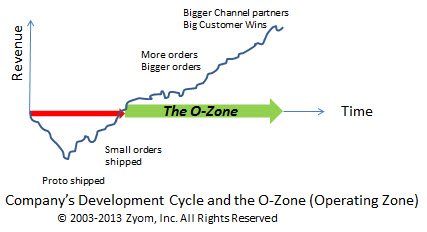
1) How does a young company know when they have entered the Operating or ‘O’-Zone? Over the last 4+ years we had the privilege of watching a company (Ruckus Wireless www.ruckuswireless.com) blossom into a significant player in a newer segment of the networking industry. As a solution provider, we have worked and thought hard about the development lifecycles of high growth, high change industries for over a decade, wondering how & when a company knows that they have come of age, or entered the critical ‘O’-Zone, as we define it. O for Operating. As defined in a previous blog (http://bit.ly/MemoToChiefExec ) young Product companies that enter the O-Zone see big changes- from shipping 10s or 100s of units a month of a handful of products, they are quickly thrust into a bigger, rapidly growing Operation – 1000s, potentially tens of 1000s of units being shipped, and this transition can be a mean one. Managing this transition requires the ambidextrous qualities of careful orchestration as well as rapid,intuitive decision-making and execution.
This year we got some great data-points. Those at the forefront of Supply and Sales Operations functions– Order Fulfillment, Supply Chain, Channel Sales managers – enjoy a key vantage point to see this transition as it unfolds. This valuable insight (that a young Product company has entered the O-Zone) if utilized in a timely manner can be harnessed for a greater Operating advantage that can be sustainable over several years.
2) Where do the Highest Impact Collaboration initiatives spring from? How? – As young companies enter the Operating Zone of their development cycle, processes and systems related to collaboration cannot be left to chance or management directives. Systematic Collaboration becomes especially critical between functions that may appear to have conflicting objectives and metrics in the near-term – for example, Sales focus on Revenue Growth and Ops on Cost Control. However, collaboration cannot be regimented through management directives. The genesis of high impact collaboration initiatives happens usually in the trenches, and its success rests exclusively on the efforts of those that get the work done. Take the case of ProductCo – a Product Company (all names changed for anonymity).
As volumes have grown quickly at ProductCo, fulfilling orders in a timely manner has become challenging for Operations. Shelley in Supply Chain Ops figures out that she ships a portion of products every week to the same Distribution partners and her colleague on the Channel Sales side – Julia – needs support. Support, so she can systematically compile sales data, interact with her Distribution partners effectively to understand downstream demand and provide quick signals back to Shelley in Ops, with all the data literally at her fingertips. Shelley (Supply Chain) runs this need by her manager, who points them to a systems vendor for brainstorming. Out of Julia (Sales) interactions with the vendor springs a collaborative system which will yield data and demand insights for the ProductCo in the near-term and on an ongoing basis. No major hullabaloo over the choice of systems, just a single-minded focus on working jointly with the vendor, across functions to improve the customer experience – through faster and accurate collaboration utilizing fresh data. All this happened because the initial thought to change came from within, was nurtured by a progressive management and collaboration culture, and effectively implemented working with a solution vendor as a partner.
Leaping forward in 2014.. and beyond
a) Collaborating systematically across functions and partners will gain traction going beyond cookie-cutter approaches : 2014 will see the onset of specialization in a critical collaboration area- Sales & Operations Planning and Execution. Dynamic companies will demand more than the cookie cutter approaches that have been offered to date. Industry specialization, smarter demand management methods, more tailored data and workflow linkages which will result in a faster and smarter collaboration between Sales, Supply Chain and their partners.
b) Leading companies and younger aspirants will refocus on profitability and away from a singular focus on Revenue growth only– Whether motivated by competition, financial valuations, cost of capital or more mundane business prudence, leading Product companies will focus back to product and operational profitability, and will be rewarded richly (http://reut.rs/1hagYpN ). Those that fall short will start seeing their valuations drop, resulting in erosion in market standing over time. Profitable Revenue growth will become the mantra of those who are at the head of the pack and intend to stay there.
c) System Implementation will capture center stage as a core success factor : As the botched rollout of the Affordable Care Act (ACA) website revealed (http://bit.ly/ObamacareIssues), bringing a website “up” is no guarantee of its success. Systems implementation requires a rich, complex set of interconnected activities to be completed in a timely and cost effective manner. This fate has also befallen many a system implementations in the private sector too. Since private companies can afford to throw a blanket of secrecy over such bungling, we hear only of the spectacular failures (http://ubm.io/JpGedn). 2014 and beyond will bring renewed focus to the arts and sciences of effective systems implementation.
The tide is turning. Channel partners and key customers are moving fast to your products..
Just as you were preparing to hear the beautiful humming sound of a well-oiled Operating machine shipping products out – you hear some ugly, jarring noises –
‘Hot-selling product has gone on allocation’
‘Big Channel partners are getting frustrated, as lead times start creeping up’
What happened? The Critical ‘O’-Zone
First, the good news – You have reached a major inflection point in your development cycle. You are no longer a small, obscure supplier waiting for the next large order. Orders are now waiting for you. Congratulations!
The not-so-good news – these orders will not wait long before they jump ship to a competitor.. Channel partners may divert attention to these competitors too.. So, what happened?
You just entered what we call the ‘O’ Zone (the “Operating” Zone). This is that part of your lifecycle (“zone”) when customers want to see you Operate like clockwork– shipping out 10x, 100x or more volume than before, yet meeting delivery dates globally, at attractive price points.
What happens in this vital phase of your Company’s development cycle is going to be determined in a big way by a critical collaboration – Near Real-time Collaboration between your Salesand Manufacturing/ Supply Chain Operations (Ops) team.
What’s causing these pains? No ‘growing pains’ is not a good label. Here is a critical one–
Divergent metrics & its impact on Sales & Operations
Your Sales team is focused on hyper-growth – signing up new Channel partners, winning new deals with end customers despite tough competition.
They are totally focused on order volume (Revenue) metrics, and compensated appropriately. So, they make sure they open up the gates and get more customers, more partners and more orders in. But hold on!
Do they have enough time to pivot to their Ops partners – give them a heads up about new customers, what product forecasts will be like?
Your Ops team, on the other hand, has an increasingly complex balancing act as demand takes off. They can grow their Supply Networks – to an extent (signing up new sources – new CM/ ODMs, new suppliers, etc.) to gain extra capacity, but then they hit the brick wall – of ‘Cost’ centered metrics.
The strains start to show in interactions between Sales & Ops.
The offshoot of all this is not pretty – As orders increase, Ops fulfillment can be in lock step only for a little while, after which demand and supply diverge. For Ops, it becomes a guessing game –
Q. What will Sales sell? How much buffer stock should we keep?
For Sales it becomes a hand-wringing exercise, as they field questions from customers –
Q. When will our orders ship? Why can’t you deliver it sooner?
With ‘Keep cost down’ as the guiding principle for Ops, it becomes a crazy dash to expedite when demand swings up with little notice, flying goods over instead of the more inexpensive modes (sea, rail or road) – depleting margins.
The human costs are bigger – anxieties mount as Sales & Ops try to play a game which looks somewhat like – catch the ball ‘blindfolded’.
Key to growth – A Vital, Systematic collaboration
In the O-Zone (operating zone) we need to play carefully – Pay special heed to the needs of this collaboration which is vital for growth –
Between Sales & Supply Chain Operations
To start off – Metrics need to be aligned.
How about rallying both Sales & Ops around ‘Profitable Growth’ metrics?
Let’s discuss it as a team at the leadership levels first. At a minimum – Sales, Supply Chain Operations, Operational Finance and you, should participate. The dividends of playing smart in the O-Zone are huge – Growth with Profitability – A distinct Operating Advantage. We, at Zyom, will be glad to help and explain further.






 respond2demand - Zyom Blog